Materials used in flexible PCBs
Unlike rigid PCBs that use a glass fiber and epoxy base, flexible circuit boards use a polyimide or polyester substrate. They are much thinner and offer great flexibility. The base also provides heat resistance and chemical resistance for assembly, soldering, and cleaning.
The conductive copper layer is deposited on the substrate using a variety of methods, such as electro-deposition and rolled and annealed. The type of copper used determines a flexible pcb ability to bend, as well as its resistance and performance. In addition, the thickness of the copper foil is crucial for flex PCBs.
To prevent the copper from tearing or breaking during production, it is often etched with a precise pattern of circles, ovals, and arcs. This technique reduces the stress that is placed on the conductive traces, and it also increases the etch yield. It is important to keep flex areas clear of discontinuities like vias, cut-outs, slits, and holes. These can cause bending stress and failures. Instead of hole-filled plated through-holes, it is recommended to use teardrop (pad fillet) shaped vias.
A flex PCB’s outer layers are covered with a coverlay film that insulates the surface conductors and protects them from corrosion, moisture, and damage. This material is often created from PI or PET, but it can also be made with other materials such as FR4 or phenolic resin. Conductor traces on a flex circuit are typically made from copper, and they can be plated using either panel plating or pad-only plating (button plating). With button plating, the copper is only applied to the vias pads.
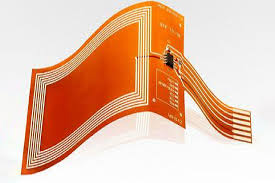
What materials are used in flexible PCBs?
Flexible printed circuit boards (PCBs) represent a significant advancement in electronic design, offering unique advantages such as flexibility, reduced weight, and compact size. They are used in a wide range of applications, from consumer electronics to medical devices. The materials used in flexible PCBs are crucial in determining their performance, durability, and overall functionality. This article explores the primary materials employed in flexible PCBs and their roles.
Polyimide is the most commonly used substrate material for flexible PCBs. It is known for its exceptional thermal stability, chemical resistance, and mechanical properties. Polyimide can withstand high temperatures, making it suitable for applications where thermal stability is crucial. Its flexibility allows it to be bent and twisted without compromising its integrity, which is essential for creating compact and conformable electronics.
Polyester, particularly polyethylene terephthalate (PET), is another substrate material used in flexible PCBs. PET is less expensive than polyimide and offers good mechanical properties and flexibility. However, it does not have the same high-temperature resistance as polyimide, which limits its use to applications where lower thermal performance is acceptable.
Liquid Crystal Polymer is used in some high-performance flexible PCBs due to its excellent electrical properties, dimensional stability, and thermal resistance. LCP has a very low dielectric constant, which helps in minimizing signal loss and maintaining high-speed signal integrity. It is often used in high-frequency applications and advanced electronics where performance is critical.